Commercial Water Damage Restoration: How Top-Down Drying Works
Water damage does not always require extensive demolition. Learn how Coastal's specialized drying approach can help preserve suitable materials and reduce the repairs that follow.

After a leak in a commercial building, the visible water may be only part of the damage. Moisture can spread beneath flooring, behind cabinetry, and into walls or ceiling assemblies. For owners and property managers, the next question is practical: can those materials be dried in place, or will they need to be removed?
At Coastal Risk Management, our commercial water damage restoration work includes Top-Down Drying, a heat-assisted approach designed to help preserve suitable building materials. When conditions allow, drying in place can reduce demolition, limit reconstruction, and help businesses recover with less disruption.
Why commercial water damage needs a careful drying plan
Water can move beyond the room where a leak begins. In offices, schools, entertainment facilities, and multifamily buildings, it may affect adjoining spaces, layered flooring, wall cavities, or areas above suspended ceilings.
The surface can appear dry while moisture remains elsewhere in the assembly. Before recommending treatment, Coastal evaluates the water source, affected materials, contamination concerns, and moisture readings.
The property's use also matters. Access, tenant needs, sensitive finishes, and operational priorities help shape a practical restoration plan. The aim is to address the affected areas while avoiding unnecessary removal of materials that can be restored.
What is Top-Down Drying?
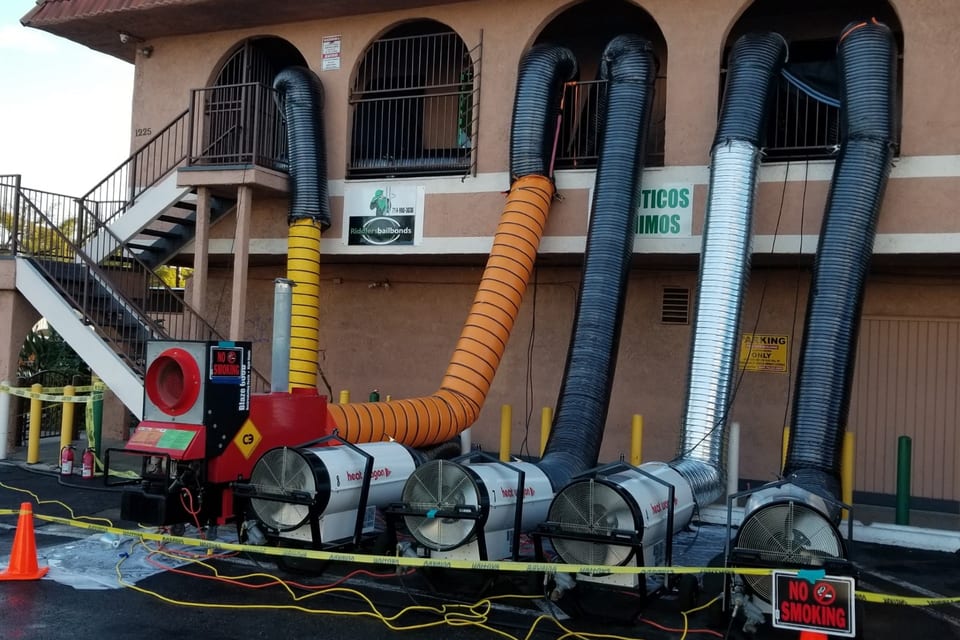
Coastal uses Top-Down Drying to help dry suitable water-damaged materials in place. Our approach combines controlled heat and directed airflow, with high-pressure air delivery where appropriate to reach affected cavities and confined spaces.
Three components support the treatment:
- Controlled heat: Heat helps moisture evaporate from affected materials. Temperatures are selected and monitored according to the materials, finishes, and contents involved.
- High-pressure air delivery: Where appropriate, specialty equipment uses controlled air pressure to deliver air through planned access points into affected cavities or confined spaces.
- Directed airflow: Air movement carries evaporated moisture away from wet materials and along managed drying paths.
Moisture released during treatment must also be removed from the drying environment. Equipment placement, air paths, and ongoing monitoring help keep the treatment suited to the building's conditions.
When can commercial building materials be dried in place?
Drying in place may be appropriate when the affected materials remain restorable, contamination can be properly addressed, and the proposed treatment is compatible with the building assemblies and finishes.
It can be especially valuable where removal would involve:
- Hardwood or specialty flooring that is costly or difficult to replace.
- Built-in cabinetry, millwork, or custom architectural finishes.
- Extensive access work followed by additional reconstruction.
- Disruption to occupied spaces or business operations.
Coastal evaluates these factors before recommending a method. Preserving materials is a priority where it is safe and practical, rather than a promise that every component can remain.
Some materials still require removal because of contamination, deterioration, loss of integrity, or an inability to dry effectively in place. Controlled heat also needs careful application: sensitive materials and finishes may require a different approach.
Can advanced drying reduce restoration costs and downtime?
It can, particularly when drying in place avoids demolition and rebuilding that would otherwise be necessary.
Retaining suitable flooring, cabinetry, and finishes can reduce removal, debris disposal, replacement, and reconstruction costs. It may also reduce the repair work that must be completed before a space can return to use.
The relevant comparison is the complete restoration scope, including drying and the repairs that follow. Savings depend on the water damage, contamination, material condition, and treatment requirements. A project that needs material removal will have different options from one where the affected finishes can be retained.
A Coastal project: preserving flooring at Segerstrom Center for the Arts
At Segerstrom Center for the Arts in Costa Mesa, a soda-machine leak caused moisture to migrate beneath the flooring. Coastal used Top-Down Drying to address the affected materials in place.
The area reached its target moisture levels in four days, and the flooring was retained. The result illustrates why the drying strategy matters: the project addressed the moisture while preserving the existing floor.
See this project and other examples in Coastal's restoration portfolio.
How Coastal plans and monitors commercial drying
Every water loss requires an assessment of the actual building conditions. Coastal's approach includes:
- Assessing the affected areas. We evaluate the water source, moisture spread, contamination, and material condition.
- Defining the restoration scope. We identify appropriate drying methods and any necessary cleaning, containment, or material removal.
- Applying controlled treatment. Controlled heat, directed airflow, and appropriate pressure-delivery equipment are arranged to address suitable affected materials.
- Monitoring progress. Temperature, humidity, and material moisture readings guide adjustments and document drying progress.
- Planning the repairs. Once affected areas have reached the appropriate drying goals and any necessary remediation is complete, reconstruction can proceed.
Coastal can also handle the rebuilding through Coastal Construction Services, our reconstruction and remodeling division. That keeps drying, related remediation, and necessary repairs coordinated within one company.
Is Top-Down Drying the same as structural pasteurization?
The processes can take place together, but they have different objectives. Drying removes excess moisture. Structural pasteurization is an engineered thermal treatment with specific temperature and exposure-time requirements.
On many projects, Coastal combines structural drying and structural pasteurization during the same treatment. The thermal treatment requires appropriate temperatures and exposure times; using heat for drying alone does not establish that pasteurization has been achieved.
Necessary cleaning and mold removal remain part of the restoration plan. Killing mold alone is insufficient because the mold must also be removed.
Questions property managers should ask before work begins
A clear drying plan should explain:
- Which areas and materials are affected?
- What can be dried in place, and what requires removal?
- How will moisture levels and drying progress be documented?
- How will access, occupants, and business operations be considered?
- Who will complete any necessary repairs?
These questions help connect the technical drying work with the practical decisions needed to restore the property.
Discuss a commercial water loss with Coastal
Coastal Risk Management provides specialized drying and water damage repair services for commercial properties in Orange County. Learn more about our water damage restoration approach, or contact Coastal to discuss the affected areas and appropriate next steps.
Have questions about water damage, mold, or restoration? Our team is available to assess your property and answer your questions.
Request an AssessmentExplore Topics
Written by
Coastal Risk Management
IICRC-certified water damage restoration and environmental remediation specialists serving Orange County for over 25 years.

